INPA: Intelligent Automation of Incoming Utilization Requests

Rising transaction traffic increases, high quality requirements, and limited personnel capacity are presenting corporate lending back offices with growing challenges. At the same time, processing incoming requests and notifications from borrowers or agent banks in loan servicing continues to depend heavily on manual work. Reviewing emails, extracting relevant information, and transferring it into the lending system consumes personnel resources and incurs avoidable costs.
With the development of the INPA app, short for “Incoming Notice Processing Automation,” Finbridge GmbH & Co. KG has created a solution that automates this process. INPA receives incoming messages, classifies them, extracts relevant data, validates it against the lending system, and transfers the results. Only complex or ambiguous cases are presented to employees for review.
This enables banks to reduce their processing effort, improve data quality, and cope with rising volumes without a proportional increase in staffing.
Notice Processing: A Time-Consuming and Error-Prone Process
Processing incoming requests and notifications is still largely manual at many banks. Every incoming email has to be assessed for relevance, its key content extracted, interpreted, matched to the right deal and facility, and finally booked in the lending system. This process requires specialized expertise, consumes considerable resources, and is prone to transcription and entry errors. As business volume increases, email volume and thus processing effort rise nearly proportionally. Scaling is therefore often only possible through additional personnel capacity. At the same time, skilled labor shortages, peak workloads, and strict regulatory requirements make flexible operational expansion challenging.
The Solution: End-to-End Automation with INPA
INPA automates the processing workflow from the moment an email arrives until its input into the lending back-office system. The workflow consists of five sequential stages:
- Email Monitoring: Receipt of incoming messages
- Categorization: Categorization of messages by type
- Data Extraction: Extraction of relevant data
- Matching: Reconciliation with existing data in the lending system
- Data Capture: Creation or updating of data in the lending system
The system automatically receives incoming emails, checks their relevance, and categorizes relevant messages. Subsequently, INPA extracts the required information and reconciles it with existing data in the lending system.
The quality of the match is assessed and displayed transparently. Where the match is sufficiently strong, the data can proceed to automated downstream processing, while ambiguous cases are routed for manual review. Depending on configuration, insights from already-processed cases can be used as additional context for comparable transactions, allowing the system to learn independently.
In the final process step, the application updates values in the lending system or creates new transactions.
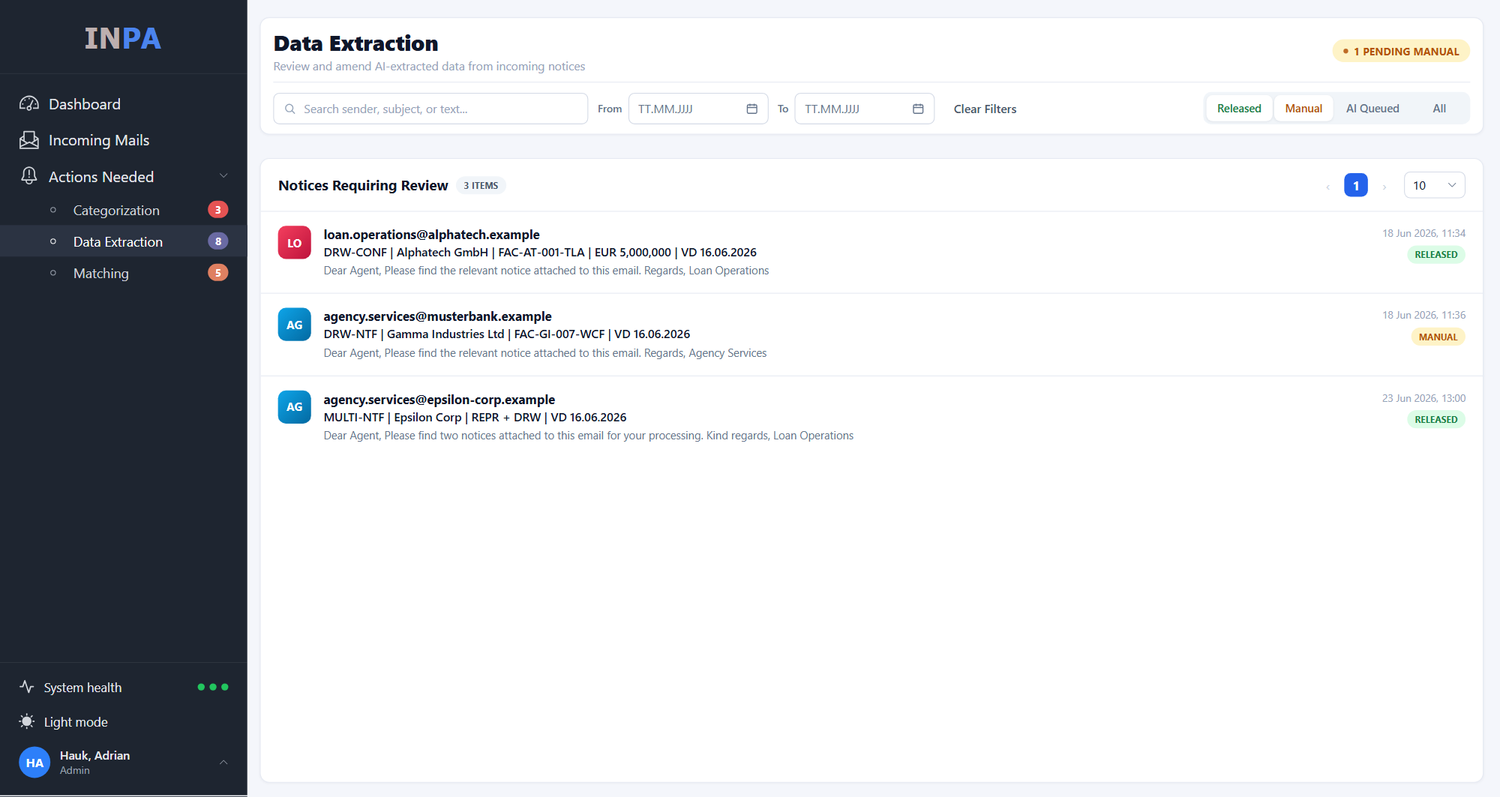
The bank always retains control: transactions can be viewed, reviewed, and processed manually. Thus, INPA combines a high degree of automation with the transparency and control required for the lending business (see Figure 1).
Measurable Value for the Corporate Lending Back Office
With INPA, employees focus on complex or ambiguous cases, while standard cases are processed automatically. This reduces average processing time and releases qualified capacity for more challenging, value-adding, or controlling activities.
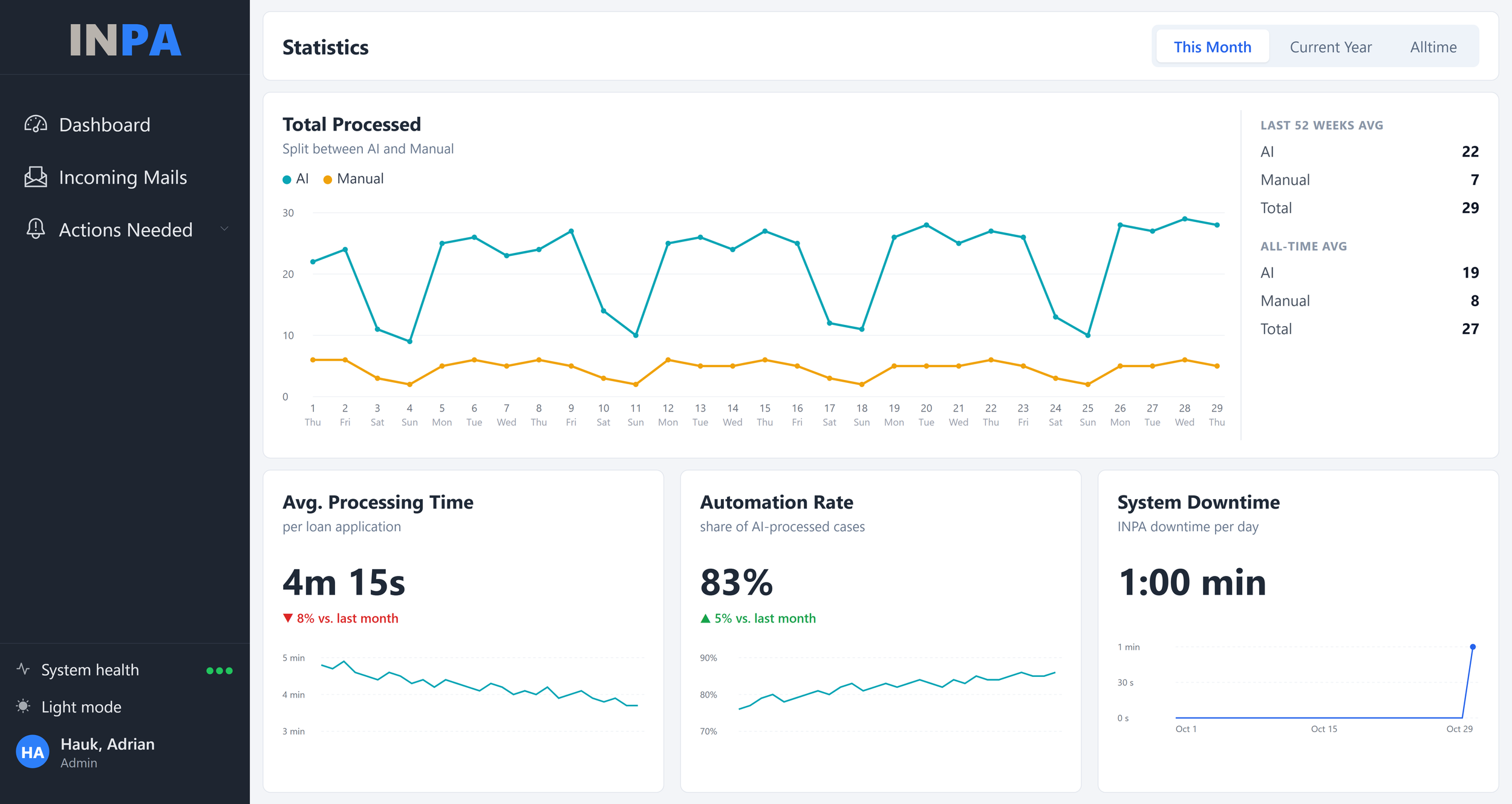
The INPA dashboard shows the distribution between automated and manually processed cases, average processing time, and automation rate over time. Banks can continuously measure the success of automation and identify further optimization potential.
Automated processing reduces the risk of transcription errors, promotes consistent data capture, and decreases downstream review and correction effort. Reconciliation with existing entries in the lending system further supports reliable assignment of incoming information.
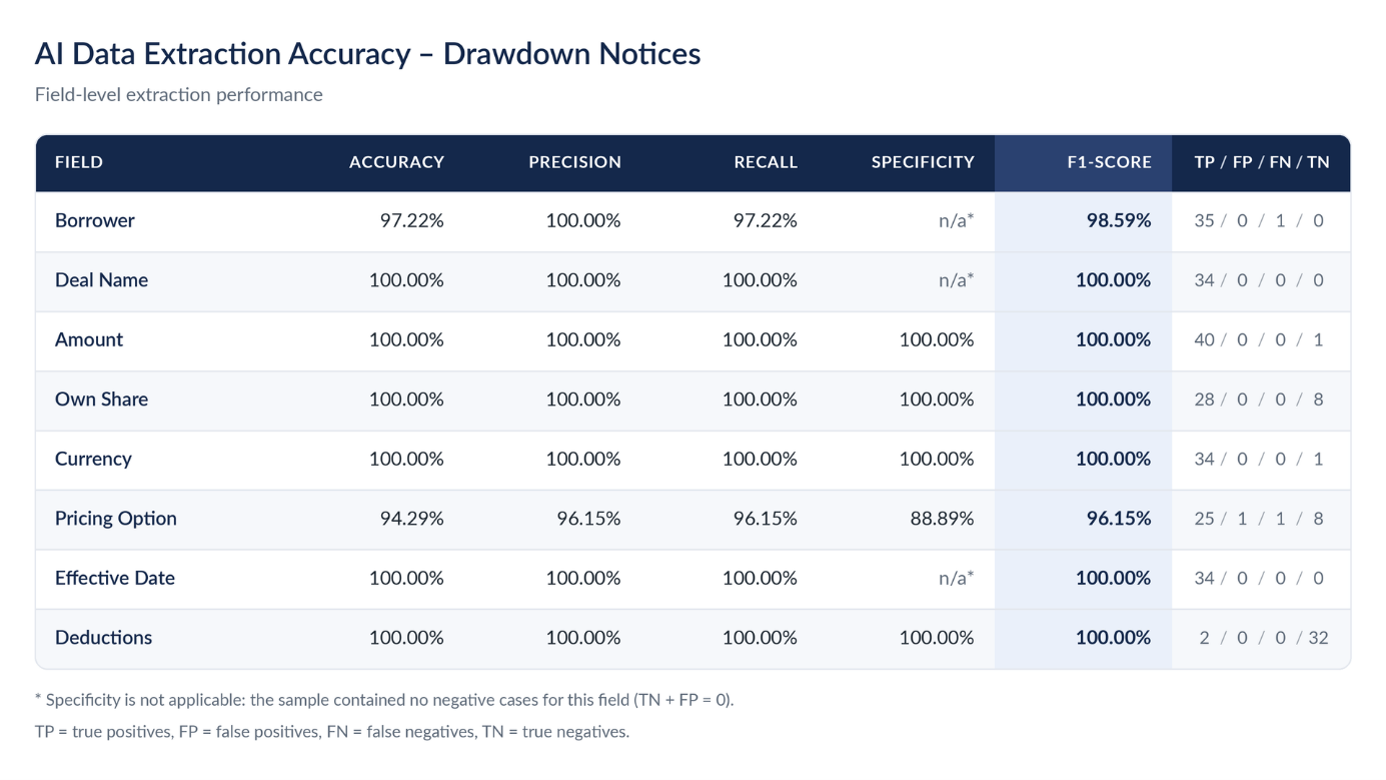
When processing a representative set of actual disbursement requests, INPA identified six of eight examined data fields without error. For the remaining two fields, accuracy was more than 96 percent each.
Even as email traffic increases, INPA can process additional volumes without requiring proportional expansion of processing capacity. The application thus lays the foundation for lastingly more efficient processes and further business growth.
Key Advantages at a Glance
- Reduced manual processing effort: Standard cases are processed largely automatically.
- Growing automation rate: Insights from processed cases improve processing of comparable transactions.
- Shorter processing times: Relevant information is automatically recognized, assigned, and processed.
- Higher data quality: Consistent entries reduce transcription errors and correction effort.
- Targeted use of expertise: Employees focus on complex and ambiguous cases.
- Transparent control: Processing results and assignments remain traceable at all times.
- Scalable processes: Growing volumes do not require proportional expansion of personnel capacity.
- Integration into existing systems: Standard interfaces facilitate integration into existing IT landscapes.
- Flexibility in AI usage: Banks can integrate a large language model already deployed in-house.
Flexible, Secure, and Modern Software Architecture
INPA features a modern and clear browser-based user interface and is not tied to any specific AI model. Instead, banks can integrate their own large language model already deployed in-house and adapt the AI component to their technological and security requirements. This allows them to maintain control over the models used and the processing of sensitive data.
The lean architecture and concise, rule-based instructions limit token consumption and thus the ongoing costs of the AI model. INPA can be operated with a small, cost-efficient model by default.
Context-Based Processing
In the standard configuration, INPA requires no sample documents. If needed, however, the application can be expanded with a module based on retrieval-augmented generation (RAG). It draws on relevant content from previously processed documents as additional context, including any that were manually corrected. This allows the application to learn on its own and improve continuously, tailoring its results ever more closely to each institution’s documents, formats, and requirements.
End-to-End Audit Trail
The system records the entire path of a message – from inbox through categorization, extraction, and matching to booking in the lending system. Beyond status changes, it also logs processing and validation results, approvals, and any staff interventions. As a result, it is always clear what was processed, checked, or amended, when this occurred, and whether approval was automatic or manual.
Business Configurable Validation Rules
The business side can manage validation rules without programming. Authorized users set conditions, thresholds, sequences, and actions to be triggered via the user interface. The same rules apply to both automatic processing and manual review. Manual approvals overriding triggered validation rules are also logged.
Roles and Permissions
Users and roles are managed via Microsoft Entra ID by default but can also be managed within the application itself. A role-based authorization concept governs which users can view transactions and which roles are permitted to modify configurations or rules.
In this way, INPA combines automated processing with the control and traceability required by regulated processes in the lending business.
Stability Through Decoupled Processing
External systems such as Microsoft Exchange, OCR services, or LLMs are connected via REST APIs. Internal processing between individual INPA services is managed asynchronously via message queues. Through this decoupling, neither time-intensive AI calls nor the temporary failure of a single component blocks the entire system. This supports the application’s stability, scalability, and maintainability.
Integration into Existing System Landscapes
Standard interfaces and consistent alignment with established industry standards facilitate INPA’s integration into existing system landscapes. These include out-of-the-box connectivity to Microsoft Exchange for receiving incoming emails, to Microsoft Entra ID for controlling roles and permissions, and to the corporate lending system Finastra Loan IQ. Fundamental changes to the existing system architecture are not required. Implementation can proceed incrementally – for example, initially for selected loan products, organizational units, or message types such as utilization requests and repricings/rollovers.
Corporate Lending Expertise Meets AI Competence
Since 2007, Finbridge regularly supported six major and regional banks across the corporate lending business. Thanks to this long-standing collaboration, the company possesses solid knowledge of both loan processes and the system landscapes in use.
INPA combines this business and technological expertise with our experience in artificial intelligence in a quickly deployable solution that reduces manual processing effort, improves data quality, and reliably scales even as email volume grows.
Discover Your Back Office’s Automation Potential
We would be happy to show you in a free product demo how INPA processes incoming lending notifications and can be integrated into your existing system landscape. If you wish, we can also work with you to analyze a selected process or a representative set of documents and identify the specific automation potential for your corporate lending back office.
Schedule your personal INPA demo now.
Contact

Andreas Thiel
Partner
E-Mail: andreas.thiel@finbridge.de
Author


Further Insights